



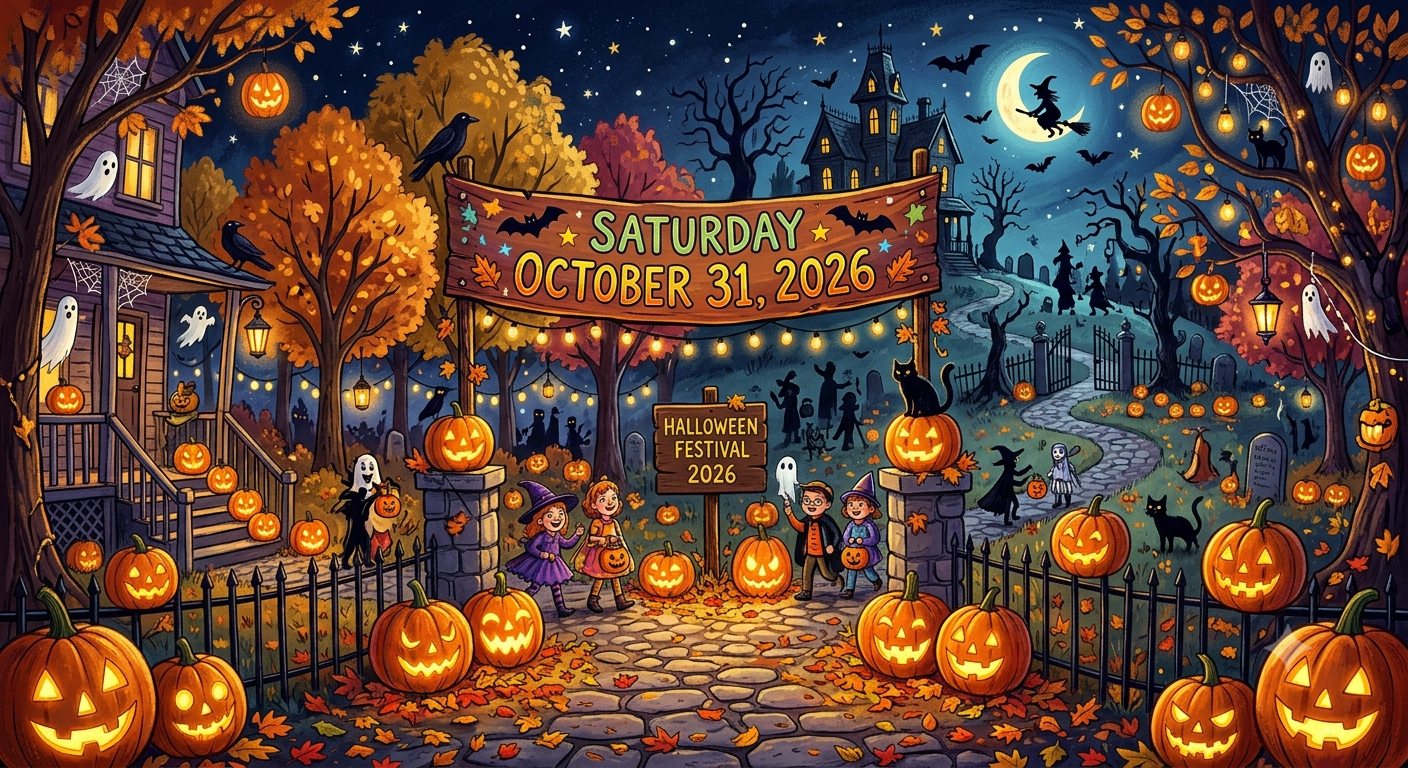
Halloween 2026 falls on Saturday, October 31. Halloween is always celebrated on October 31st, the evening before All Saints’ Day on November 1, and this year it lands on a Saturday. That means no school night, no early alarm the next morning, and a full evening of trick-or-treating, costume parties and glowing jack-o’-lanterns.
If you’re reading this in the last week of October, you have only a few days left to pull everything together. Don’t panic. This guide covers everything you need to plan Halloween this year:
- The exact date and day of the week for Halloween 2026
- Trick-or-treating times and how a Saturday Halloween changes them
- When Halloween is celebrated around the world, from the USA and UK to Finland and Australia
- Why Halloween is celebrated, from the ancient Celtic festival of Samhain to Stingy Jack
- A last-minute planning checklist and answers to the most common questions
When Is Halloween 2026? Date and Day of the Week
Halloween 2026 is on Saturday, October 31, 2026. It’s the first Saturday Halloween since 2020, and the next one won’t come around until 2037, so this year is worth making the most of.
Halloween 2026 Falls on Saturday, October 31
When Halloween falls on a Saturday, almost everything about the holiday gets easier:
- No school night. Kids can stay out a little later, and nobody has to rush through homework before heading door to door.
- Parties on the actual night. In most years, Halloween parties get pushed to the nearest weekend. In 2026, the weekend is Halloween.
- More time for daytime fun. Parades, pumpkin patches, trunk-or-treats and costume contests can run all afternoon before trick-or-treating starts.
- A bonus hour in the US and Canada. Daylight saving time ends at 2 a.m. on Sunday, November 1, so Halloween night is effectively an hour longer for anyone staying up late.
Halloween Is Always on October 31 (It Never Moves)
Unlike Thanksgiving or Easter, Halloween has a fixed date. It always falls on October 31, no matter what day of the week that is. Only the day of the week changes from year to year. The date is tied to All Saints’ Day on November 1, and “Halloween” itself is short for All Hallows’ Eve, the evening before that feast.
Halloween 2026 at a Glance
| Detail | Info |
| Date | October 31, 2026 |
| Day of the week | Saturday |
| Day after | All Saints’ Day (Sunday, November 1) |
| Two days after | All Souls’ Day (Monday, November 2) |
| US/Canada clocks fall back | Sunday, November 1, at 2 a.m. |
| Last Saturday Halloween | 2020 |
| Next Saturday Halloween | 2037 |
| Halloween 2027 | Sunday, October 31 |
When Is Halloween 2026 Trick or Treat?
Trick-or-treating for Halloween 2026 happens on Saturday evening, October 31. Most neighborhoods go door to door from roughly 5:30 p.m. to 8:30 p.m. local time, but many towns post official hours, so check your city or county website before you head out.
What Time Does Trick-or-Treating Start in 2026?
There’s no national start time. In practice, trick-or-treating usually begins around sunset and winds down a few hours later:
| Group | Typical window |
| Toddlers and young kids | 4:00–6:00 p.m., while it’s still light |
| School-age kids | 5:30–8:00 p.m. |
| Teens | 7:00–9:00 p.m. |
| Most official town hours | Around 5:00/6:00 p.m. to 8:00 p.m. |
In the US and Canada, clocks don’t fall back until the morning after Halloween, so sunset on October 31 will still be on daylight time. In the UK and Ireland, the clocks change on October 25, which means it’ll be dark by around 5 p.m.
How a Saturday Halloween Changes Trick-or-Treating
A Saturday Halloween usually means busier streets and earlier starts. Expect:
- More trick-or-treaters at your door than in a weekday year, so buy extra candy
- Earlier starts, since families don’t have to wait for school and work to end
- Longer nights for older kids and teens, with no school the next morning
- Fewer rescheduled events, since some towns move trick-or-treating off Sundays but rarely off Saturdays
Trunk-or-Treat and Daytime Alternatives
If door-to-door isn’t practical, look for trunk-or-treat events, where families decorate their car trunks in a school, church or community parking lot and hand out candy. Malls, libraries and downtown business districts also often run daytime trick-or-treating, which is ideal for little ones.
How to Trick-or-Treat Safely: Step by Step
- Check your local hours on your town, city or county website.
- Plan your route through well-lit streets you know, and agree on a meeting point.
- Make costumes visible with reflective tape, glow sticks or a flashlight.
- Choose face paint over masks so kids can see clearly.
- Stick with a group and have an adult accompany younger children.
- Only visit homes with porch lights on, a long-standing signal that treats are available.
- Inspect candy at home before anyone digs in, especially for allergens.
When Is Halloween 2026 Around the World?
Halloween 2026 falls on Saturday, October 31, in every country that celebrates it. The date doesn’t change from place to place. What changes is how big the celebration is and which holidays sit next to it.
Halloween 2026 Dates by Country
| Country | Halloween 2026 | What makes it different |
| USA | Saturday, October 31 | The biggest celebration anywhere: trick-or-treating, haunted houses, costume parties |
| UK | Saturday, October 31 | Trick-or-treating and parties; Bonfire Night follows on November 5 |
| Ireland | Saturday, October 31 | The birthplace of Samhain; bonfires, barmbrack and a bank holiday on Monday, October 26 |
| Canada | Saturday, October 31 | Very similar to the US, often with snow boots under the costume |
| Spain | Saturday, October 31 | All Saints’ Day (Todos los Santos) on November 1 is a public holiday |
| France | Saturday, October 31 | A smaller party night; La Toussaint on November 1 is the main observance |
| Finland | Saturday, October 31 | All Saints’ Day (Pyhäinpäivä) also lands on October 31 this year |
| Australia | Saturday, October 31 | Growing fast; celebrated in spring with longer, warmer evenings |
| South Africa | Saturday, October 31 | Mostly themed parties, events and shopping-center activities |
| Mexico | Saturday, October 31 | Leads straight into Día de los Muertos on November 1–2 |
Halloween in the USA
Americans go all-in. According to the National Retail Federation, 74% of US consumers plan to celebrate Halloween in 2026, up from 68% in 2019. Expect official trick-or-treat hours, neighborhood haunted houses, pumpkin patches and costume parties that spill well past midnight on a Saturday night.
Halloween in the UK and Ireland
Halloween has deep Irish and Scottish roots, so it never feels like an import here. In Ireland, the October bank holiday falls on Monday, October 26, 2026, and many schools take mid-term break around it. In the UK, Halloween kicks off a run of autumn celebrations that ends with Bonfire Night on November 5.
Halloween in Canada
Canada celebrates almost exactly like the US: door-to-door trick-or-treating, carved pumpkins and plenty of school costume days. The main difference is the weather, which often means costumes built around a warm coat.
Halloween in Spain and France
In both countries, Halloween is a modern, mostly youth-driven party night. The bigger traditional date is November 1, All Saints’ Day, when families visit cemeteries to honor loved ones. In Catalonia, people celebrate La Castanyada around the same time with roasted chestnuts and sweet potatoes.
Halloween in Finland
Finland has one of the most interesting calendars this year. Finnish All Saints’ Day (Pyhäinpäivä) is held on the Saturday between October 31 and November 6, so in 2026 it lands on the same day as Halloween. Expect candlelit cemeteries alongside Halloween parties, a quiet, reflective tradition and a modern one sharing the same night.
Halloween in Australia and South Africa
In the Southern Hemisphere, Halloween arrives in spring, not autumn. Australia has embraced trick-or-treating in a big way over the last couple of decades, especially in suburban neighborhoods. In South Africa, Halloween is smaller and centers on costume parties, themed events and mall activities.
Halloween vs. Día de los Muertos
Día de los Muertos is not “Mexican Halloween.” It’s a separate celebration on November 1–2 that honors deceased loved ones with altars (ofrendas), marigolds, photos and favorite foods. Halloween has spooky roots in the idea of spirits roaming the earth; Día de los Muertos is a joyful reunion between the living and the dead. In Mexico and much of the US, the two now sit side by side.
Why Is Halloween Celebrated?
Halloween is celebrated because of the ancient Celtic festival of Samhain, which marked the end of the harvest and the start of the dark half of the year. The Celts believed the boundary between the living and the dead grew thin that night. Christianity later turned the date into All Hallows’ Eve, the evening before All Saints’ Day.
The Ancient Celtic Festival of Samhain
More than 2,000 years ago, the Celts of what is now Ireland and Scotland, Britain and northern France marked their new year around November 1. Samhain (pronounced SOW-in) was a festival marking the shift from the bright, growing season to the cold, dark months.
The Celts believed that on the night of Samhain, spirits could wander the earth. People lit huge bonfires, left out food and offerings, and sometimes wore disguises so that wandering spirits wouldn’t recognize them. Those customs are the seeds of almost everything we do on Halloween today.
From All Hallows’ Eve to Halloween
As Christianity spread through Europe, the church folded older festivals into its own calendar. In the 8th century, Pope Gregory III dedicated a chapel in Rome to all the saints on November 1, and the feast later spread across the Western Christian church as All Saints’ Day, also called All Hallows’ Day. November 2 became All Souls’ Day, a day for offering prayers for the dead.
The night before All Hallows’ Day was known as All Hallows’ Eve. Over time, “All Hallows’ Eve” shortened to Hallowe’en, which simply means the evening before the hallows (saints). That’s why Halloween is always on October 31.
How Halloween Came to America
Halloween crossed the Atlantic in the 1800s with waves of Irish and Scottish immigrants, many fleeing the Irish Potato Famine. They brought their customs of guising, fortune-telling and carved lanterns. By the early 20th century, Halloween had turned into the community-focused holiday we know today, and by the 1950s trick-or-treating was a fixture of American neighborhoods. That blend of ancient ritual and neighborhood fun is what makes modern Halloween so distinctive.
History of Halloween Traditions
Most Halloween traditions trace back to Irish, Scottish and English folk customs. Here’s where the big ones came from.
Stingy Jack and the Jack-o’-Lantern
The jack-o’-lantern comes from an Irish folktale about a man named Stingy Jack who tricked the devil, twice. When Jack died, heaven wouldn’t take him and the devil wouldn’t either. He was sent to roam the dark with only a burning coal, which he placed inside a hollowed-out turnip to light his way. People in Ireland and Scotland began carving scary faces into turnips and potatoes to keep “Jack of the Lantern” and other spirits away.
From Turnips to Pumpkins
When Irish immigrants arrived in North America, they found pumpkins: bigger, softer and much easier to carve than turnips. Pumpkin carving quickly took over, and the glowing orange jack-o’-lantern became the symbol of Halloween. Today, carving pumpkins is one of the most popular Halloween activities in the US.
Soul Cakes and the Roots of Trick-or-Treating
In medieval Britain and Ireland, poor people went door to door on All Souls’ Day, offering prayers for the dead in exchange for small spiced pastries called soul cakes. In Scotland and Ireland, young people went “guising,” dressing up and performing a song, poem or joke for a treat. These traditions involving costumes and doorstep visits evolved into the American phrase “trick or treat” in the 1920s and 1930s.
Costumes and Disguises
The first Halloween disguises were meant to fool roaming spirits. Over the centuries, the Halloween costume shifted from protection to pure fun. Today, it’s the centerpiece of the holiday, from homemade ghosts to blockbuster superheroes.
| Tradition | Where it started | How it lives on |
| Bonfires | Celtic Samhain | Bonfires and fire festivals, especially in Ireland |
| Carved lanterns | Irish turnip lanterns | Pumpkin jack-o’-lanterns |
| Soul cakes / souling | Medieval Britain and Ireland | Trick-or-treating for candy |
| Guising | Scotland and Ireland | Costumes and party performances |
| Spirits and ghosts | Celtic belief about Samhain | Haunted houses and ghost stories |
How People Celebrate Halloween Today
Halloween is bigger than ever in 2026. The National Retail Federation expects Americans to spend a record $13.5 billion on Halloween this year, or about $115.14 per person, based on a survey of 7,889 consumers conducted September 1–9, 2026.
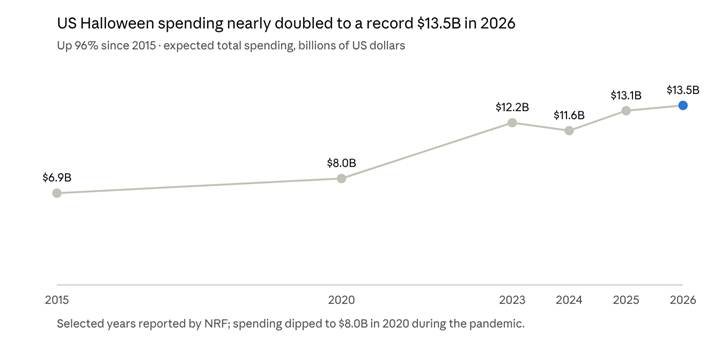
Source: National Retail Federation Halloween surveys (2015–2026), via NRF and NGPF
Spending has almost doubled in a decade, and 2026 tops last year’s record of $13.1 billion. That’s despite cost worries: 79% of shoppers expect tariffs to push Halloween prices higher, and 34% plan to buy items they can reuse in future years.
Where the Halloween Money Goes in 2026
| Category | Expected spending | Share of shoppers buying |
| Costumes | $4.4 billion | 71% |
| Decorations | $4.3 billion | 78% |
| Candy | $4.1 billion | 96% |
| Greeting cards | $0.8 billion | 42% |
Within costumes, about $1.5 billion goes to children’s costumes (Spider-Man tops the list) and another $920 million goes to pet costumes, with pumpkins, hot dogs and ghosts leading the way for four-legged trick-or-treaters.
Popular Halloween Activities
The most popular Halloween activities include:
- Trick-or-treating door to door or at trunk-or-treat events
- Pumpkin carving and decorating jack-o’-lanterns
- Costume parties and Halloween parties with friends
- Haunted houses, hayrides and corn mazes
- Scary movie marathons at home
- Decorating front yards, porches and windows
- Bonfires, ghost stories and apple bobbing
Halloween Traditions That Have Stuck Around
Notice how many of these echo the past: bonfires come from Samhain, jack-o’-lanterns from Stingy Jack’s turnip, and trick-or-treating from soul cakes and guising. People celebrate Halloween today in a thoroughly modern way, but the bones of the holiday are centuries old.
Planning Halloween 2026: Tips for a Saturday Celebration
With Halloween 2026 on a Saturday, you can plan a full day of fun instead of squeezing everything into a weeknight. Here’s a simple countdown to get it done.
Last-Minute Halloween Planning Checklist
- Lock in costumes (4–5 days out). Shop your closet first; NRF found 34% of shoppers plan to reuse or repurpose items this year. Superheroes, witches and ghosts are easy to pull together.
- Check local trick-or-treat hours (4 days out). Look up your town’s official times and any trunk-or-treat or parade events.
- Buy candy (3 days out). Expect more trick-or-treaters than usual on a Saturday. Pick up a few allergy-friendly or non-food treats too.
- Pick and carve pumpkins (2 days out). Carving too early can leave you with a soggy jack-o’-lantern by Saturday night. Rub petroleum jelly on cut edges to keep them fresh longer.
- Decorate (1–2 days out). Light your porch well. A lit porch tells trick-or-treaters you’re open for business.
- Plan the day (Friday). Map out daytime events, a trick-or-treat route and any evening Halloween parties. Keeping costs down? Mix Halloween night with some of the best free things to do in London during the day.
- Enjoy Halloween night (Saturday, October 31). Start trick-or-treating around sunset, then wind down with a scary movie, a party or a bonfire.
Making the Most of a Saturday Halloween
- Morning: Visit a pumpkin patch, farmers market or Halloween parade.
- Afternoon: Join a trunk-or-treat or let little ones trick-or-treat at local shops while it’s light.
- Early evening: Classic door-to-door trick-or-treating from about 5:30 p.m.
- Night: Costume parties, haunted houses or a Halloween night movie marathon. In the US and Canada, you even get an extra hour when the clocks fall back.
Actionable takeaway: If you do only three things this week, check your local trick-or-treat hours, buy more candy than you think you need, and carve your pumpkin no earlier than Thursday. Since Halloween 2026 falls on a Saturday, it’s the perfect excuse to pair spooky plans with other things to do in London this weekend.
Halloween Dates for Upcoming Years
The date of Halloween never moves; only the day of the week does. Bookmark this table for planning ahead:
| Year | Date | Day of the week |
| 2026 | October 31 | Saturday |
| 2027 | October 31 | Sunday |
| 2028 | October 31 | Tuesday |
| 2029 | October 31 | Wednesday |
| 2030 | October 31 | Thursday |
| 2031 | October 31 | Friday |
Halloween 2027 lands on a Sunday, so expect some towns to shift trick-or-treat hours earlier. In 2031, a Friday Halloween will bring back the weekend-party feel. The next Saturday Halloween after this year won’t arrive until 2037.
Frequently Asked Questions About Halloween 2026
When is Halloween 2026?
Halloween 2026 is on Saturday, October 31, 2026. Halloween is always celebrated on October 31, the evening before All Saints’ Day on November 1.
What day of the week is Halloween 2026?
Halloween 2026 falls on a Saturday. It’s the first Saturday Halloween since 2020, and the next one won’t happen until 2037.
When is Halloween 2026 trick or treat?
Trick-or-treating takes place on the evening of Saturday, October 31, 2026, usually from about 5:30 p.m. to 8:30 p.m. Many towns set official hours, so check your local government website.
Why is Halloween celebrated on October 31?
Halloween comes from the ancient Celtic festival of Samhain, held at the end of the harvest, when Celts believed spirits could cross into the world of the living. The church later made November 1 All Saints’ Day, and October 31 became All Hallows’ Eve, or Halloween.
Is Halloween on the same day in every country?
Yes. Halloween is October 31 everywhere it’s observed, including the USA, UK, Canada, Ireland, Spain, France, Finland, Australia and South Africa. Customs and nearby holidays differ from country to country.
Is Halloween a public holiday?
No, not in the US, UK, Canada or Australia. However, November 1 (All Saints’ Day) is a public holiday in countries such as Spain and France, and in 2026 Finland’s All Saints’ Day falls on October 31 itself.
What’s the difference between Halloween and Día de los Muertos?
Halloween (October 31) grew from Celtic and Christian traditions about spirits and saints. Día de los Muertos (November 1–2) is a Mexican celebration that honors deceased family members with altars, marigolds and favorite foods. They’re separate holidays with different meanings.
When is Halloween 2027?
Halloween 2027 is on Sunday, October 31, 2027.
How much will Americans spend on Halloween 2026?
The National Retail Federation expects a record $13.5 billion in Halloween spending in 2026, or about $115 per person, with costumes, decorations and candy each topping $4 billion.
Make the Most of Halloween 2026
Halloween 2026 falls on Saturday, October 31, and that makes this one of the best Halloweens in years. No school night, no rushing home from work, and a whole day to fill with pumpkins, parades, costumes and candy. Check your local trick-or-treat hours, stock up on treats, and enjoy a holiday that’s been bringing people together since the days of Samhain.
Once the pumpkins are gone, the next big date is Black Friday. Find out when Black Friday is in the UK.
What are you dressing up as this year? Share your costume ideas in the comments, and bookmark this page so you know exactly when Halloween falls next year.
