



Ever found yourself in an awkward conversation where you accidentally called the entire United Kingdom “England”? Or maybe you’ve wondered why your British friend corrected you when you said “Great Britain” instead of the “UK”? You’re not alone. The overlapping terms used to describe this Atlantic archipelago confuse millions of people worldwide, from travelers planning their first trip to journalists reporting international news.
Understanding the real differences between Great Britain, United Kingdom, British Islands, and British Isles isn’t just about geography trivia. These distinctions matter in political contexts, sports competitions, travel planning, and respectful communication with people from these regions. The good news? Once you grasp the basic framework, these terms become surprisingly simple to remember.
In this comprehensive guide, we’ll break down each term with clear definitions, visual comparisons, and practical examples. By the end, you’ll confidently know when to use Britain vs UK, understand what makes the British Isles different from the British Islands, and never mix up England with the entire United Kingdom again.
Why This Confusion Exists (And Why It Matters)
The terminology surrounding this region is genuinely complex, and there’s a legitimate reason why so many people struggle with it. Unlike most countries with straightforward names, this northwestern European islands region involves layers of geographic, political, and historical distinctions that don’t always align neatly.
Historical Context Explained
The confusion stems from centuries of evolving political unions and changing boundaries. The name origins history reveals that these terms developed at different times for different purposes:
- “British Isles” emerged as a geographic term describing the entire archipelago, dating back to ancient Greek and Roman geographers
- “Great Britain” became prominent after the 1707 Acts of Union joined England and Scotland, later including Wales
- “United Kingdom” evolved through multiple unions, with its current form established in 1922 after Irish independence
- “British Islands” is a modern legal and political term that includes the UK plus Crown Dependencies
The territorial extent has shifted dramatically over the centuries. At various points, British political control extended across Ireland, contracted after Irish independence in 1922, and continues to encompass Northern Ireland while maintaining unique relationships with the Isle of Man and Channel Islands.
These changes occurred gradually, which explains why people often use outdated terms or apply geographic labels to political entities. The Commonwealth connections further complicate matters, as dozens of former British territories maintain cultural and political ties despite being independent nations.
Common Mistakes Avoided
Understanding the most frequent errors helps you sidestep embarrassment and demonstrate cultural sensitivity. Here are the top mistakes:
- Using “England” to mean the entire UK – England is just one of four constituent countries
- Assuming “British” only refers to people from Britain – Northern Irish people may identify as British despite not living on the island of Great Britain
- Thinking Ireland is part of the UK – The Republic of Ireland has been independent since 1922
- Using “British Isles” in formal contexts with Irish people – Many find this term politically problematic
- Forgetting Northern Ireland when saying “Great Britain” – The UK includes Northern Ireland; Great Britain doesn’t
These distinctions appear in real-world scenarios constantly. During the Olympics, athletes compete for “Team GB” (Great Britain and Northern Ireland), but in football and rugby, England, Scotland, Wales, and Northern Ireland field separate teams as the “home nations.” News reports about UK government policy affect all four constituent countries, while stories about British geography might only discuss the main island.
The British identity cultural landscape is equally nuanced. Someone from Scotland might strongly identify as Scottish rather than British, while someone from Northern Ireland might identify as British, Irish, or Northern Irish depending on their background and perspectives.
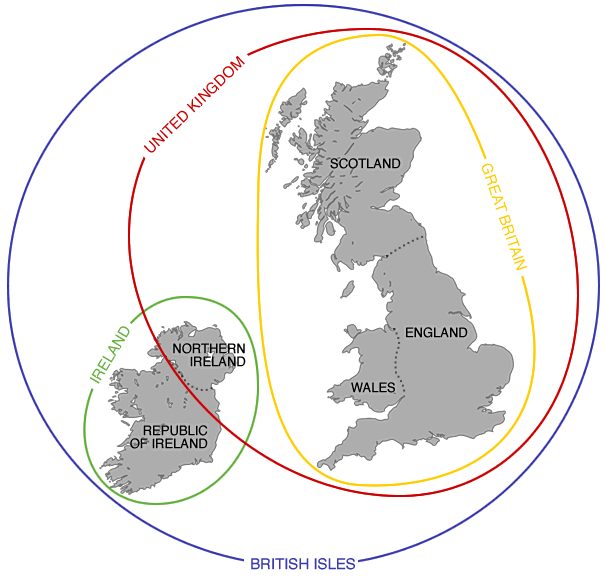
The British Isles: Understanding the Archipelago
Let’s start with the broadest geographic term, which encompasses everything else we’ll discuss.
British Isles Meaning and Geographic Scope
The British Isles is a purely geographic term describing an island archipelago located off the northwestern coast of continental Europe. This Atlantic archipelago location includes over 6,000 islands, though only a small percentage are inhabited.
The British Isles include:
- Great Britain (the largest island)
- Ireland (the second-largest island)
- The Isle of Man
- The Hebrides
- The Orkney Islands
- The Shetland Islands
- The Channel Islands
- Thousands of smaller islands
This Anglo-Celtic isles region spans approximately 315,159 square kilometers (121,684 square miles) and is home to roughly 72 million people across two sovereign nations (the UK and the Republic of Ireland) plus the Crown Dependencies.
From a geographic boundaries perspective, the British Isles are bordered by the Atlantic Ocean to the west and north, the North Sea to the east, and the English Channel to the south. This positioning has profoundly influenced the region’s history, climate, and cultural development.
Size area comparison: The British Isles are larger than New Zealand but smaller than Japan, making them a moderately-sized archipelago by global standards.
Islands Comprising Britain and Beyond
The major islands within this archipelago each have distinct characteristics:
Great Britain – The largest island at 209,331 km², containing England, Scotland, and Wales. Its size makes it the ninth-largest island in the world and the largest in Europe.
Ireland – The second-largest at 84,421 km², politically divided between the Republic of Ireland and Northern Ireland. The island sits to the west, separated from Great Britain by the Irish Sea.
Celtic nations included in the smaller islands bring unique cultural and linguistic heritage. The Isle of Man sits in the Irish Sea between Britain and Ireland, while the Hebrides, Orkney, and Shetland Islands extend north and west of Scotland.
The Channel Islands (Jersey, Guernsey, and smaller islands) sit in the English Channel closer to France than to Britain, yet maintain political ties to the British Crown.
The Controversy: Why Some Avoid This Term
Here’s where geography meets politics: while “British Isles” is geographically accurate, it’s politically sensitive for many people from the Republic of Ireland.
The concern is that “British” in the name implies political association with Britain or the United Kingdom, which doesn’t reflect Ireland’s status as a completely independent nation since 1922. Some Irish people and organizations prefer alternative terms like:
- “Britain and Ireland”
- “These Islands”
- “The Atlantic Archipelago”
- “The Islands of the North Atlantic” (IONA)
In practical usage examples, the Irish and British governments often use “these islands” in official communications to remain neutral. Academic geographers continue using “British Isles” as a value-neutral geographic descriptor, while being mindful of the political sensitivities in certain contexts.
When to use it: The term remains standard in geographic, geological, and ecological contexts where purely physical description is intended, with no political implications.
Great Britain Explained: The Main Island
Now we move from the entire archipelago to focus on one specific island – the big one that gives the region much of its name.
What Is GB? Geographic Definition
Great Britain is the name of the largest island in the British Isles archipelago. It’s a purely geographic term referring to a landmass, not a political entity. Think of it as you would “Madagascar” or “Borneo” – it’s simply an island’s name.
The British mainland of Great Britain measures approximately 209,331 square kilometers (80,823 square miles) and stretches roughly 970 kilometers (600 miles) from its northernmost point in Scotland to its southernmost tip in England.
Great Britain includes:
- The entire landmass of the main island
- Numerous smaller surrounding islands that are part of England, Scotland, or Wales
- Islands like the Isle of Wight, Anglesey, and the Isles of Scilly
Great Britain does NOT include:
- Northern Ireland (which is on the island of Ireland)
- The Isle of Man (a separate island)
- The Channel Islands (separate islands)
The name “Great” Britain distinguishes this larger island from “Brittany” (in French, “Bretagne”), a region in northwestern France. The term has been used since medieval times, with ancient Greek geographer Ptolemy referring to the larger island as “Great Britain” and Ireland as “Little Britain.”
England Scotland Wales: The Three Nations
The island of Great Britain is politically divided among three of the UK’s four constituent countries. Each maintains distinct cultural identities, legal systems, and increasingly, devolved governmental powers.
England’s Role and Geography
England occupies the southern and central portions of Great Britain, making it the largest of the three nations by both area (130,279 km²) and population (approximately 56 million people).
Key facts about England:
- Capital: London (also the UK capital)
- Population distribution: Over 80% of the UK’s total population
- Includes major cities: Manchester, Birmingham, Liverpool, Leeds, Newcastle
- Home to diverse geography from flat eastern regions to the hilly Lake District and Cotswolds
England’s demographic and economic dominance often leads to the common error of using “England” interchangeably with the UK – a mistake that understandably frustrates Scottish, Welsh, and Northern Irish people.
England’s capital, London, offers far more than just famous landmarks. Take time to discover London’s hidden gems and unique experiences beyond the typical tourist trail.
Scotland Highlands Lowlands
Scotland comprises the northern third of Great Britain, covering 77,933 km² with a population of approximately 5.5 million people.
Distinctive Scottish features:
- Capital: Edinburgh (though Glasgow is larger)
- Scotland highlands lowlands divide creates dramatic geographic contrast
- Contains the UK’s highest peak: Ben Nevis (1,345 meters)
- Over 790 islands, including the Hebrides, Orkney, and Shetland
- Devolved governments give Scotland significant autonomy over education, health, and law
Scotland maintained a separate legal system even after the 1707 union with England, and languages spoken include English, Scots, and Scottish Gaelic.
Wales: The Western Nation
Wales occupies the western portion of Great Britain, covering 20,779 km² with about 3.1 million people.
Welsh characteristics:
- Capital: Cardiff
- Mountainous terrain dominated by the Cambrian Mountains and Snowdonia
- Languages spoken: Both English and Welsh (Cymraeg) are official languages
- About 30% of the population speaks Welsh, making it one of Europe’s most successful indigenous language preservation efforts
- Strong cultural heritage including distinct traditions, literature, and music
Wales was formally united with England in 1536 but has experienced a cultural revival in recent decades, with increased devolution of governmental powers since 1999.
Comparison of the three nations:
| Nation | Area (km²) | Population | Capital | Highest Point |
|---|---|---|---|---|
| England | 130,279 | ~56 million | London | Scafell Pike (978m) |
| Scotland | 77,933 | ~5.5 million | Edinburgh | Ben Nevis (1,345m) |
| Wales | 20,779 | ~3.1 million | Cardiff | Snowdon (1,085m) |
United Kingdom Definition: The Political Union
Now we transition from geography to politics. While Great Britain is an island, the United Kingdom is a country – a sovereign state with international recognition, UN membership, and its own government.
UK vs Great Britain: The Critical Difference
Here’s the essential distinction that clarifies so much confusion:
Great Britain = Geographic term for an island United Kingdom = Political term for a country
The United Kingdom (officially: the United Kingdom of Great Britain and Northern Ireland) is a sovereign state and constitutional monarchy that includes:
- England (on the island of Great Britain)
- Scotland (on the island of Great Britain)
- Wales (on the island of Great Britain)
- Northern Ireland (on the island of Ireland)
The critical difference: The UK includes Northern Ireland, while Great Britain doesn’t. This single distinction is what separates the two terms.
Think of it this way: If you’re discussing the physical landmass, use “Great Britain.” If you’re discussing the country, government, or political matters, use “United Kingdom” or “UK.”
Examples of correct usage:
- “The United Kingdom left the European Union in 2020” (political)
- “Great Britain is separated from continental Europe by the English Channel” (geographic)
- “I’m traveling around Great Britain, visiting England, Scotland, and Wales” (geographic)
- “UK citizens carry British passports” (political)
Four Constituent Countries Explained
The UK’s structure is unique in that it’s a sovereign state composed of four constituent countries. This isn’t the same as a federal system like the United States or Germany – it’s a distinct constitutional arrangement.
The four constituent countries:
- England – No devolved government; governed directly by the UK Parliament
- Scotland – Has a devolved Scottish Parliament with powers over education, health, justice, and more
- Wales – Has a devolved Welsh Parliament (Senedd) with similar but slightly different powers
- Northern Ireland – Has a devolved Assembly with power-sharing arrangements due to its unique political situation
Northern Ireland explained: This region represents the most complex part of the UK’s structure. It comprises six counties in the northeast of the island of Ireland that remained part of the UK when the rest of Ireland gained independence in 1922. The Irish Sea geography separates it from Great Britain, making it the only UK constituent country not on the British mainland.
The Good Friday Agreement (1998) established peace after decades of conflict and created unique arrangements where people born in Northern Ireland can identify as British, Irish, or both, and hold either or both passports.
UK Government Structure and Administration
The British government structure operates as a constitutional monarchy with parliamentary democracy:
National Level:
- Monarch: King Charles III (ceremonial head of state)
- Prime Minister: Head of government
- Parliament location: Westminster, London
- Two chambers: House of Commons (elected) and House of Lords (appointed)
Devolved Governments:
- Scotland: Scottish Parliament in Edinburgh (129 Members)
- Wales: Senedd in Cardiff (60 Members)
- Northern Ireland: Northern Ireland Assembly in Belfast (90 Members)
This devolution means that laws about education, healthcare, and many other matters can differ across the UK’s constituent countries. For example, university tuition policies, healthcare systems, and even the legal drinking age can vary.
Sovereignty and governance ultimately resides with the UK Parliament in Westminster, which retains the power to legislate on any matter and theoretically could dissolve the devolved institutions (though this would be politically explosive).
Practical examples of UK unity:
- British passports are issued to all UK citizens regardless of which constituent country they’re from
- Currency: The pound sterling is used throughout (though Scotland and Northern Ireland issue their own notes)
- Defense and foreign policy: Controlled entirely at UK level
- Home nations sport: Teams compete separately in football, rugby, and other sports, but together in the Olympics
Britain vs UK: Direct Comparison
Let’s directly compare these two commonly confused terms with practical examples and visual clarity.
Geographic Boundaries Map Analysis
Understanding the geographic boundaries helps visualize the distinction:
Great Britain’s boundaries:
- Surrounded entirely by water
- North Sea to the east
- Atlantic Ocean to the north and west
- English Channel to the south
- Irish Sea to the west (between Britain and Ireland)
- Includes territorial waters extending 12 nautical miles from the coast
United Kingdom’s boundaries:
- Includes all of Great Britain’s boundaries
- PLUS the land border between Northern Ireland and the Republic of Ireland (499 km long)
- PLUS Northern Ireland’s coastline and territorial waters
- British territorial extent covers approximately 242,495 km² of land
The English Channel position is particularly important historically – this narrow strait (at its narrowest, just 33 km wide) has shaped British history by providing both defense from invasion and connections to continental Europe via the Channel Tunnel.
Britain UK Difference in Practical Terms
Here’s when to use each term correctly in real-world contexts:
Use “Great Britain” or “Britain” when:
- Describing the island’s geography or physical features
- Discussing travel that doesn’t include Northern Ireland
- Referring to the Olympic team (officially “Team GB” though it includes Northern Ireland athletes)
- Talking about the main island’s size, climate, or geological features
Use “United Kingdom” or “UK” when:
- Discussing politics, government, or legislation
- Referring to international relations or UN membership
- Talking about UK-wide policies or statistics
- Describing citizenship or passport issues
- Discussing the country as a political entity
Comparison in specific contexts:
| Context | Use Britain/GB | Use UK | Why |
|---|---|---|---|
| Olympics | “Team GB” | “UK athletes” | Historical naming, though includes NI |
| Football World Cup | ❌ | “England team” | Home nations compete separately |
| EU Membership (historical) | ❌ | “UK left the EU” | Political decision by country |
| Geography lesson | “Britain is an island” | ❌ | Physical geography |
| Weather forecast | “Britain will see rain” | “UK weather” | Both acceptable |
| Passport | ❌ | “UK passport” | Political document |
| Currency pound sterling | ❌ | “UK currency” | National currency |
| Timezone GMT | “Britain uses GMT” | “UK uses GMT” | Both acceptable |
| Driving side UK | “In Britain, drive left” | “In UK, drive left” | Both accurate |
Travel and tourism: When planning a trip, saying “I’m visiting Britain” typically means England, Scotland, and Wales. “I’m visiting the UK” could include Northern Ireland. Being specific prevents confusion.
Sports contexts provide perfect examples of the complexity. The UK competes as one team in the Olympics but as four separate teams (England, Scotland, Wales, Northern Ireland) in football’s World Cup – these are the “home nations” that compete independently in many sports.
British Islands Overview: The Lesser-Known Term
Now we encounter the term that even many British people don’t know: the British Islands. This is neither a typo nor a synonym for the British Isles – it’s a distinct political and legal term.
What Are the British Islands?
The British Islands is a legal term defined in the Interpretation Act 1978 (UK legislation). It encompasses:
- The United Kingdom (all four constituent countries)
- The Crown Dependencies (Isle of Man, Jersey, Guernsey)
Notice what’s NOT included: The Republic of Ireland and other islands that are part of the British Isles geographically but not politically connected to the UK.
British Islands vs British Isles distinction:
| British Isles (Geographic) | British Islands (Political/Legal) |
|---|---|
| All islands in the archipelago | UK + Crown Dependencies only |
| Includes Republic of Ireland | Excludes Republic of Ireland |
| Over 6,000 islands | Significantly fewer |
| Geographic descriptor | Legal definition |
| ~72 million people | ~68 million people |
This term appears primarily in legal contexts, financial regulations, and administrative documents. You’re unlikely to encounter it in everyday conversation, but it’s crucial for understanding the legal relationships between the UK and the Crown Dependencies.
Practical usage examples: The British Islands are relevant when discussing:
- Financial regulations and tax treaties
- Travel rights and border controls
- Legal jurisdictions and appeals processes
- Citizenship and nationality laws
Crown Dependencies Overview
The Crown Dependencies are three island jurisdictions that have a unique constitutional relationship with the UK. They’re self-governing territories, but they’re not sovereign nations, nor are they part of the United Kingdom.
Key characteristics of Crown Dependencies:
- Not part of the UK, but not independent countries either
- The British monarch is their head of state (in a different constitutional role than in the UK)
- They have their own governments, laws, and tax systems
- The UK is responsible for their defense and international representation
- UK citizenship rules don’t automatically apply to islanders
Isle of Man Explained
The Isle of Man sits in the Irish Sea between Great Britain and Ireland, covering 572 km² with about 85,000 residents.
Distinctive features:
- Has the world’s oldest continuous parliament: Tynwald, established in 979 AD
- Self-governing with its own tax system (popular for offshore finance)
- Famous for the Isle of Man TT motorcycle race
- Has its own language: Manx Gaelic (being revived)
- Issues its own currency (Manx pounds, equivalent to British pounds)
Political position: The Isle of Man is a Crown Dependency, meaning it’s not part of the UK but owes allegiance to the British Crown. UK laws don’t automatically apply unless specifically extended to the island.
Channel Islands Location and Status
The Channel Islands are a group of islands in the English Channel, closer to France (just 14 miles away) than to Britain.
The main islands:
- Jersey (118 km², ~106,000 people) – The largest Channel Island
- Guernsey (63 km², ~63,000 people) – Includes several smaller islands under its jurisdiction
- Smaller inhabited islands: Alderney, Sark, Herm
Unique characteristics:
- Only parts of the British Isles occupied by Germany during World War II
- Popular tourist destinations with French cultural influences
- Mild climate due to proximity to continental Europe
- Major international finance centers with favorable tax regimes
- French place names but English-speaking populations
How Crown Dependencies Differ
The Crown Dependencies have a unique political position that confuses many people:
They are NOT:
- Part of the United Kingdom
- Part of the European Union (even before Brexit)
- Represented in the UK Parliament
- Subject to all UK laws automatically
They ARE:
- Self-governing in most domestic matters
- Under the royal family jurisdiction (the Crown)
- Dependent on the UK for defense and international relations
- Able to set their own tax rates and financial regulations
- Part of the Common Travel Area with the UK and Ireland
UK citizenship variations: People born in Crown Dependencies before 1983 didn’t automatically receive UK citizenship. Current rules are complex, but generally, Crown Dependencies residents have British citizenship but with some different rights than UK residents.
UK vs England: Clearing Up the Biggest Confusion
This is perhaps the most common and frustrating error for people from Scotland, Wales, and Northern Ireland – when others use “England” to refer to the entire United Kingdom.
Why People Mix These Up
Several factors contribute to the England vs Britain confusion:
Population concentration: England contains approximately 84% of the UK’s total population (56 million of 67 million). This demographic dominance means England-focused news and culture often overshadows the other nations.
Historical dominance: England was historically the dominant power in the British Isles, with London as the political and economic center for centuries. This legacy persists in international perceptions.
Once you understand that England is just one part of the UK, you’ll be better prepared when planning your first trip to London to explore England’s capital city.
Media representation: International news often uses “England” as shorthand, particularly in American media. When major events happen in London, headlines might say “England” even though the story affects the entire UK.
Capital city: London is both England’s capital and the UK’s capital, creating conceptual overlap. The UK Parliament is in England, further blurring the distinction.
Language: “English” is the dominant language throughout the UK, even though Welsh, Scottish Gaelic, and Irish are also spoken. This linguistic association reinforces the England-UK conflation.
International sports: England’s football team is often the most visible of the home nations internationally, leading some to assume England represents the whole UK.
When Each Term Is Appropriate
Being precise shows respect and awareness of the UK’s diversity. Here’s when to use each term:
Use “England” only when:
- Specifically discussing England and nothing else
- Talking about the English football, rugby, or cricket team
- Referring to English-specific laws or policies
- Discussing geography within England
Use “UK” or “United Kingdom” when:
- Discussing national government or politics
- Referring to UK-wide statistics or policies
- Talking about international relations
- Mentioning UK citizenship or passports
Use “Britain” or “British” when:
- Describing cultural elements common across England, Scotland, and Wales
- Discussing the main island geographically
- Using informal language where precision isn’t critical
Sporting contexts perfectly illustrate these distinctions:
- Olympics: “Team GB” (though includes Northern Ireland)
- FIFA World Cup: Separate teams for England, Scotland, Wales, Northern Ireland
- Rugby Six Nations: England, Scotland, Wales compete separately
- Cricket: England and Wales play together as “England”
Flags United Kingdom also differ:
- England: White background with red cross (St. George’s Cross)
- Scotland: Blue background with white diagonal cross (St. Andrew’s Cross)
- Wales: Red dragon on white and green background
- Northern Ireland: Complex – no official flag, often use Ulster Banner
- United Kingdom: Union Jack (combines England, Scotland, and St. Patrick’s crosses)
Driving side UK: Throughout the entire UK (and Crown Dependencies), people drive on the left side of the road. This is consistent across all constituent countries.
Weather patterns Britain: While all parts of the UK are temperate maritime, there are regional variations. Scotland tends to be cooler and wetter, while southeast England is warmer and drier. Saying “England’s weather” when you mean UK-wide weather is both inaccurate and potentially irritating to Scottish, Welsh, and Northern Irish people dealing with different conditions.
Quick Reference Chart: All Terms Compared
Here’s a comprehensive comparison table showing how all four terms relate to each other – bookmark this for easy reference:
| Term | Type | What It Includes | What It Excludes | Population | Area (km²) | Key Usage |
|---|---|---|---|---|---|---|
| British Isles | Geographic | Great Britain, Ireland, Isle of Man, Channel Islands, + 6,000+ smaller islands | Nothing in the archipelago | ~72 million | ~315,000 | Geography, geology, ecology |
| Great Britain | Geographic | England, Scotland, Wales + surrounding smaller islands | Northern Ireland, Isle of Man, Channel Islands, Republic of Ireland | ~64 million | ~209,000 | Geography, island references, Team GB |
| United Kingdom | Political | England, Scotland, Wales, Northern Ireland | Isle of Man, Channel Islands, Republic of Ireland | ~67 million | ~243,000 | Politics, government, citizenship |
| British Islands | Legal/Political | United Kingdom + Crown Dependencies (Isle of Man, Jersey, Guernsey) | Republic of Ireland | ~68 million | ~244,000 | Legal documents, regulations |
Additional comparison points:
| Aspect | British Isles | Great Britain | United Kingdom | British Islands |
|---|---|---|---|---|
| Sovereign states included | 2 (UK, Ireland) | 0 (it’s an island) | 1 (the UK itself) | 1 (UK only) |
| Languages | English, Irish, Welsh, Scots Gaelic, Cornish, Manx | English, Welsh, Scots Gaelic, Scots | English, Welsh, Scots Gaelic, Irish, Ulster Scots | Same as UK + Norman French |
| Currency used | GBP (£) and EUR (€) | GBP (£) | GBP (£) | GBP (£) + local variants |
| EU membership | Part yes, part no | N/A | No (left 2020) | No |
| Olympic representation | 2 teams (UK, Ireland) | Team GB* | Team GB* | Team GB* |
*Team GB officially represents the UK, including Northern Ireland, despite the name
Memory tricks tips for this chart:
- “Island vs. Country” rule: If it has “Britain” in the name, check if you’re talking about the island (Great Britain) or the country (United Kingdom)
- “Add Northern Ireland” formula: Great Britain + Northern Ireland = United Kingdom
- “Biggest to smallest” nesting: British Isles (largest) → contains Great Britain and Ireland → Great Britain contains England, Scotland, Wales → United Kingdom = Great Britain + Northern Ireland
- “Legal lingo” reminder: British Islands is the oddball legal term you’ll rarely use
Memory Tricks Tips: Never Forget the Differences
The best way to remember these distinctions forever is through visual mnemonics and simple rules that stick in your mind.
Visual Mnemonics
The Nesting Dolls Analogy:
Imagine Russian nesting dolls (matryoshkas) that fit inside each other:
- Largest doll = British Isles (the entire archipelago)
- Second doll = Great Britain (the main island)
- Third doll = United Kingdom (the country – slightly larger than Great Britain because it includes Northern Ireland)
- Smallest doll = England (the largest constituent country)
This visual helps you remember that these aren’t competing terms but rather different-sized concepts that relate to each other hierarchically.
The Concentric Circles Visualization:
Draw or imagine concentric circles on a map:
- Outer circle: British Isles – encompasses everything
- Middle circle: Splits into Great Britain (one side) and Ireland (other side)
- Inner circles: Great Britain divides into England, Scotland, and Wales
- Separate small circle: Northern Ireland (part of UK but on the island of Ireland)
Color-coding system for maps:
- Blue: Water and geographic terms (British Isles, Great Britain)
- Red: Political entities (United Kingdom, England, Scotland, Wales, Northern Ireland)
- Green: Independent nations (Republic of Ireland)
- Yellow: Special jurisdictions (Crown Dependencies)
This color association helps your brain quickly categorize what type of term you’re dealing with.
Simple Rules to Remember
Rule 1: “Britain = Island, UK = Country”
Whenever you’re unsure, ask yourself: “Am I talking about a physical place or a political entity?”
- Physical/geographic → Britain or Great Britain
- Political/governmental → United Kingdom or UK
Rule 2: “Add Northern Ireland = UK”
The simplest formula to remember:
Great Britain + Northern Ireland = United Kingdom
If your topic involves Northern Ireland, you must say UK, not Britain.
Rule 3: “When in Doubt, Say ‘UK'”
If you’re not certain which term to use in conversation:
- Saying “UK” is rarely wrong for political contexts
- It’s more inclusive and less likely to offend
- It’s the safest choice in professional or formal settings
The Acronym EWAN:
- England
- Wales
- And
- Northern Ireland
…all together make the UK. (Scotland is implied as the fourth!)
The “Sports Test”:
- If they compete separately (like World Cup football) → they’re constituent countries
- If they compete together (like Olympics) → they’re the UK (even if called Team GB)
The “Passport Check”:
- If everyone carries the same passport → it’s the UK
- If different passports → different countries (like Republic of Ireland vs. UK)
Frequently Asked Questions
Is Britain the Same as England?
No, Britain (or Great Britain) is not the same as England. England is one country that occupies part of the island of Great Britain. The island of Great Britain contains three countries: England, Scotland, and Wales.
Using “England” when you mean “Britain” or the “UK” is one of the most common mistakes and can be offensive to Scottish and Welsh people, as it erases their national identities. England is the largest of the three nations on Great Britain by both population and area, but it’s still just one part of a larger whole.
Is Ireland Part of the UK or Great Britain?
This requires a nuanced answer because it depends on which part of Ireland you mean:
The island of Ireland is divided politically:
- Northern Ireland (6 counties) – Part of the UK, NOT part of Great Britain
- Republic of Ireland (26 counties) – An independent sovereign nation, NOT part of the UK or Great Britain
So to be clear:
- Great Britain (the island) does NOT include any part of Ireland
- The United Kingdom (the country) includes Northern Ireland but NOT the Republic of Ireland
- The British Isles (geographic archipelago) includes the entire island of Ireland
Historical context: Before 1922, all of Ireland was part of the UK. Following the Irish War of Independence and subsequent treaty, Ireland was partitioned. The majority became the independent Irish Free State (later the Republic of Ireland), while six northeastern counties remained in the UK as Northern Ireland.
What About Scotland and Wales—Are They Countries?
Yes, Scotland and Wales are countries, but with an important caveat: they’re constituent countries within the larger sovereign state of the United Kingdom, not independent sovereign nations.
What this means:
- They have distinct national identities, cultures, and histories
- They have some governmental powers through devolution
- Scotland has its own legal system, education system, and banknotes
- Wales has its own language (Welsh) with official status
- They’re not sovereign nations in the international law sense
- They can’t conduct independent foreign policy or join the UN separately
- They share UK citizenship, currency, and defense
The UK is unusual in calling its subdivisions “countries” rather than “states” or “provinces.” This reflects the historical reality that England, Scotland, and Wales were independent kingdoms before uniting, and they maintain stronger distinct identities than typical administrative regions.
Devolution means that Scotland and Wales have their own parliaments that control many domestic policies:
- Education and universities
- Healthcare (NHS in each nation operates somewhat differently)
- Housing and local government
- Some taxation powers (especially Scotland)
- Agriculture and environment
However, the UK Parliament in Westminster retains power over:
- Defense and national security
- Foreign policy and international relations
- Immigration and nationality
- Major economic policy
Do People from the UK Call Themselves British?
It’s complicated – identity in the UK is layered and personal. Most people from the UK can call themselves British, but whether they choose to varies greatly.
Common patterns:
- English people often use “English” and “British” interchangeably with little preference
- Scottish people often prefer “Scottish” to “British,” especially for cultural identity
- Welsh people typically identify strongly as Welsh first, British second
- Northern Irish people may identify as British, Irish, Northern Irish, or some combination, often influenced by their community background and political views
Many people use hybrid identities: “I’m Scottish, but I’m also British” or “I’m British, specifically Welsh.” Context matters too – someone might say “British” when abroad but “Scottish” at home.
Factors influencing identity choice:
- Age (younger people often prefer national over British identity)
- Political views (particularly in Scotland and Northern Ireland)
- Family background
- Regional pride
- Sporting contexts (people rally behind national teams)
The British identity cultural landscape is genuinely diverse. Official documents and passports say “British citizen,” but personal identity is more nuanced. This complexity is part of what makes the UK’s political and cultural makeup unique.
Why Isn’t the Republic of Ireland in the UK?
Historical timeline answer:
- 1801: Acts of Union created the United Kingdom of Great Britain and Ireland
- 1916: Easter Rising – Irish rebellion against British rule
- 1919-1921: Irish War of Independence
- 1922: Anglo-Irish Treaty partitioned Ireland; 26 counties became the Irish Free State (later Republic of Ireland), while 6 counties remained in the UK as Northern Ireland
- 1949: Ireland formally declared itself a republic and left the British Commonwealth
Why partition occurred:
- The northeastern counties (Northern Ireland) had a majority population that wanted to remain in the UK, largely due to Protestant/Unionist identity
- The rest of Ireland had a majority seeking independence
- Partition was a compromise that pleased neither side fully and contributed to decades of conflict in Northern Ireland
Today, the Republic of Ireland is:
- A completely independent sovereign nation
- A member of the European Union (unlike the UK post-Brexit)
- Has its own government, currency (Euro), and international relations
- Maintains close ties with the UK through the Common Travel Area
The Republic of Ireland has a population of about 5.1 million, its own distinct political system, and strong national identity separate from Britain, despite shared language and cultural connections.
Conclusion
After exploring these overlapping terms, here’s what you need to remember:
The core distinctions:
- British Isles = Geographic archipelago including all islands (over 6,000)
- Great Britain = The largest island containing England, Scotland, and Wales
- United Kingdom = The country/sovereign state including Great Britain + Northern Ireland
- British Islands = Legal term for UK + Crown Dependencies
The essential formula: Great Britain + Northern Ireland = United Kingdom
When to use each term:
- Geographic discussion → British Isles or Great Britain
- Political discussion → United Kingdom or UK
- Legal contexts → British Islands (rarely needed)
- Uncertain? → “UK” is usually the safest choice
These distinctions matter because they reflect real political boundaries, national identities, and cultural sensitivities. Using the correct terminology shows respect for the diverse peoples and nations within these islands. A Scottish person is British by virtue of living in the UK, but their primary identity is Scottish. An Irish person from Dublin isn’t British at all – they’re from an independent nation.
The UK structure explained in one sentence: The United Kingdom is a sovereign country composed of four constituent countries (England, Scotland, Wales, Northern Ireland), two of which (Scotland and Wales) have devolved governments, located primarily on the island of Great Britain plus part of the island of Ireland.
Once you’ve mastered British geography, you’re ready to explore iconic London neighborhoods that showcase England’s diverse culture.
