



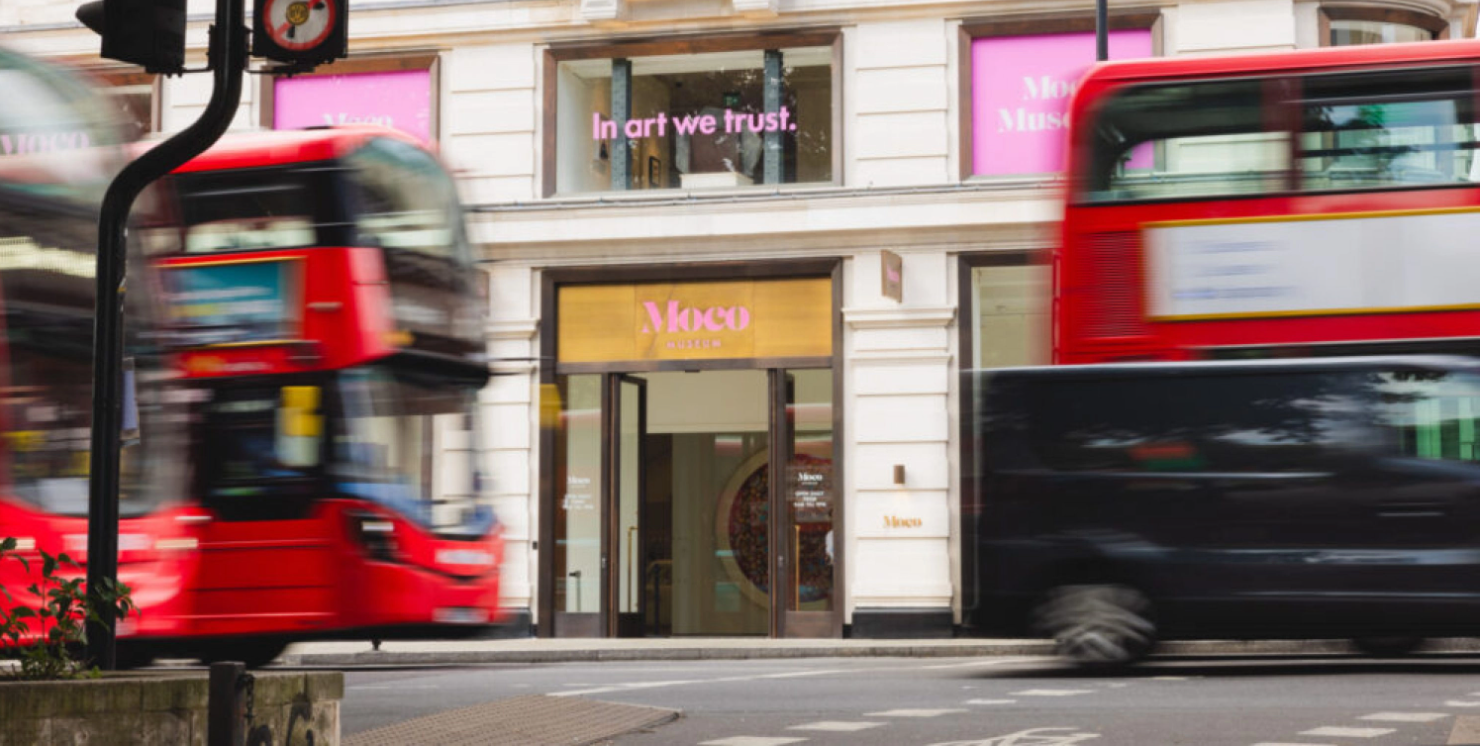
Short answer: yes, if you book General Admission and you’re new to contemporary art. No, if you’re paying VIP prices or you already spend your weekends in commercial galleries. Moco Museum London delivers roughly 90 minutes with genuine works by Banksy, Warhol, Kusama and Basquiat in a space designed to be enjoyed rather than endured — but it charges attraction prices in a city where world-class art museums are free.
That tension is the whole question. London has the Tate, the National Gallery and the V&A, none of which charge for their permanent collections. So a private art museum in London asking £16.90 to £28.90 has to earn it. Here’s what you actually get, what you don’t, and the price point where the answer flips.
What Is Moco Museum London?
Moco Museum London is an independent modern and contemporary art museum at Marble Arch, opened in August 2024 as the third and largest location in the Moco group. It shows around 100 works across three floors — paintings, sculptures, street art and digital installations — with a collection weighted towards recognisable names rather than emerging ones.
The word doing the most work in that sentence is independent. Everything else follows from it.
An independent museum, not a public institution
Moco was founded in Amsterdam in 2016 by Lionel and Kim Logchies, former art dealers, and much of what hangs on the walls comes from private holdings rather than a publicly accumulated collection. This matters for three practical reasons:
- There is no free admission scheme. Moco receives no public subsidy, so the ticket price carries the operation. The museum states this plainly on its own site.
- The collection rotates according to availability, not a curatorial programme announced years ahead. What’s on the wall in August may not be there in November.
- Curation follows appeal rather than art history. You’ll find Warhol beside a Robbie Williams canvas. That’s a feature for some visitors and the central complaint of others.
None of this makes Moco illegitimate — plenty of respected institutions are private. But if you arrive expecting a Tate-style survey of postwar art, the mismatch is on the expectation, not the museum.
How Moco London compares to Amsterdam and Barcelona
The London site is the newest and the biggest, at roughly 25,000 square feet against the townhouse footprints of its siblings. Moco reports more than six million visitors across Amsterdam and Barcelona over nine years, and its London homepage currently claims 8 million-plus globally.
Treat those numbers as self-reported and slightly inconsistent — the group’s own figures don’t reconcile neatly across pages. Independently compiled attendance data for the Amsterdam original shows a decline from about 769,000 visitors in 2023 to roughly 610,000 in 2024, a drop of around 21%. The brand is expanding while its flagship softens, which is useful context for anyone weighing whether the hype matches the experience.
Moco Museum London Tickets: What You’ll Actually Pay in 2026
Moco Museum London tickets start from £16.90 for General Admission, £23.90 for Flex and £28.90 for VIP. Every tier includes all current exhibitions and the audio tour. Children under four go free.
General Admission, Flex and VIP compared
| Ticket type | From | Time flexibility | Extras | Best for |
| General Admission | £16.90 | Fixed timed slot | Audio tour, all exhibitions | Anyone who can commit to a time |
| Flex | £23.90 | Any time during opening hours | Audio tour, all exhibitions | Tight itineraries, uncertain arrivals |
| VIP | £28.90 | Any time during opening hours | Adds a gift-shop poster | Visitors who want the print anyway |
Read that table twice, because the advertised headline price is the one you’re least likely to pay. The £16.90 figure buys a fixed entry slot; flexibility costs roughly £7 more, and the VIP tier is essentially Flex plus a poster for another £5.
There’s a defensible case for each tier and a bad case for one. If you’re a Londoner who can turn up at 10am on a Tuesday, General Admission is straightforward value. If you’re a tourist whose morning may overrun at the British Museum, Flex removes a real risk. VIP only makes sense if you were going to buy a print regardless — otherwise you’re paying gift-shop retail for a poster you didn’t choose.
Actionable takeaway: work out your ticket tier before you open the booking page, not on it. The upsell path from £16.90 to £28.90 is a 71% increase and it’s presented as three equivalent options.
Where the discounts actually are
Moco states that booking online saves up to £5 per ticket against walk-up pricing. Beyond that:
- Children under four enter free at every tier.
- Groups of more than four can request concessions by email; the museum handles group and educational bookings directly rather than through the website.
- Students and educational institutions should email rather than book online — there’s a dedicated route and concessions aren’t advertised on the ticket page.
- London Pass and Go City both include Moco, which changes the maths considerably if you’re visiting several paid attractions in a few days.
- Date changes are free up to the day of your visit through the manage-booking page, but only for tickets bought directly from Moco’s own site.
That last point is worth its own line. Reviews on Trustpilot cluster around problems with the third-party ticketing provider Moco uses, including contradictory information and unresponsive service. Book direct if you possibly can — it’s the difference between a self-service date change and an email chain.
Moco After Dark and membership
Moco periodically runs after-hours events, including a recent London night priced at £5 a ticket, and offers tiered memberships for repeat visitors. Cheap late-opening events are a good deal on their own terms. They’re also a signal: a museum confident in its £28.90 tier doesn’t usually discount to £5, even for one night. Watch the events page before paying full price for a quiet weekday.
How to book Moco Museum London tickets for the lowest price
- Check the exhibitions page first to confirm what’s actually on view — the temporary programme moves faster than third-party listings.
- Decide your tier honestly. If you can commit to a time slot, General Admission at £16.90 is the correct choice.
- Compare against a city pass if you’re visiting two or more paid attractions this trip.
- Book on mocomuseum.com rather than a reseller to keep free date changes and direct customer service.
- Choose a weekday morning slot for the quietest galleries and the best photographs.
- Bring your own headphones — the audio tour is free but you supply the hardware.
Inside 1-4 Marble Arch: The Artwork, Floor by Floor
The museum occupies 1-4 Marble Arch, W1H 7EJ, spread across three floors with four standing exhibitions. The layout is deliberately loose — no chronological walkthrough, no dense wall text — which is either liberating or frustrating depending on what you want from an art museum in London.
Modern Masters: Andy Warhol, Keith Haring and Jean-Michel Basquiat
The ground-floor rooms carry the pop art weight. Andy Warhol, Keith Haring and Jean-Michel Basquiat anchor the Modern Masters collection, joined by Jeff Koons — whose Dolphin Taz Trashcan, an inflatable dolphin suspended from a chain, greets visitors near the entrance and functions as the museum’s mission statement in a single object. It is playful, expensive, slightly absurd, and impossible to walk past without reacting.
This is also where Moco’s curatorial approach shows its strength. Seeing a Haring line drawing at eye level, uncrowded, without queuing behind forty people, is a materially better experience than seeing a more important work in a packed blockbuster show.
Banksy at Moco Museum London, and the rare Damien Hirst collaboration
Banksy is the single biggest reason most visitors buy a ticket, and Moco knows it — the Banksy exhibition sits within the Contemporary Masters collection as a permanent fixture. Expect recognisable works including Beanfield, alongside pieces that rotate in and out.
The current draw is a rare Banksy and Damien Hirst collaboration, billed by the museum as a five-month exclusive. If you have any interest in either artist, this is the strongest argument for visiting in 2026 specifically rather than someday.
One caution, because it’s the most common misconception: these are studio works, prints and canvases from private collections, not street pieces removed from walls. If your mental image of a Banksy exhibition involves the original context of the work, adjust it.
Contemporary Masters: Kusama, Murakami, KAWS, Emin, Arsham and JR
The upper floors broaden out considerably. Names you’re likely to encounter:
- Yayoi Kusama — including polka-dot pumpkin sculpture
- Takashi Murakami — Cherry Blossom Season and related work
- Damien Hirst — butterfly and spot works
- Tracey Emin — neon text pieces
- Daniel Arsham — eroded, calcified sculptural objects
- JR — a large-scale installation of a toddler at the US–Mexico border wall
- KAWS, Jeff Koons, Hajime Sorayama, Julian Opie, Invader, Lorenzo Quinn, Anthony James, Tom Wesselmann
The JR piece deserves singling out. It’s the moment the museum’s stated themes — identity, power, borders, vulnerability — stop being marketing copy and land as actual content. Visitors who arrive sceptical about Moco’s Instagram reputation tend to name this room, or the Arsham sculptures, as the point where they revised their opinion.
Because the collection rotates, treat every name above as likely rather than guaranteed. Check the artists page before travelling for one specific work.
What you won’t see at Moco Museum London
Honest expectation-setting saves more disappointment than any recommendation:
- No Kusama Infinity Mirror Room. The Kusama holdings are sculptural. This is the single most common wrong assumption.
- Around 100 works total — a focused collection, not an encyclopaedic one. You will not fill a day here.
- Minimal interpretive material on the walls. The free audio tour carries most of the context, so headphones aren’t optional if you want to understand what you’re looking at.
- No café on site at the time of writing, which is a real gap for a 90-minute visit and a repeated note in reviews.
The Digital and Immersive Art Rooms: Do They Justify the Ticket?
The contemporary and digital art component is what distinguishes Moco from a conventional gallery, and it’s also the least well explained. Prospective visitors regularly ask what “digital immersive art” actually means here, and the marketing language doesn’t help.
Six N. Five, Pulse Interactive and the mirrored installations
Concretely: the Digital and Immersive Art exhibition features work by Six N. Five and Pulse Interactive, and includes mirrored rooms filled with light and geometric reflection, projection environments, and interactive installations that respond to your presence. Anthony James’s mirrored hexagonal sculptures do something similar in physical form.
These are rooms you stand inside rather than pictures you stand in front of. Two to three of them across the visit, not a whole floor. They’re effective, they photograph extraordinarily well, and they’re the part of the museum children and reluctant teenagers engage with most reliably.
The Instagram question, answered directly
Moco gets accused of being an influencer backdrop with an art collection attached. The accusation is fair. It’s also incomplete.
Yes, the museum is engineered for photography — the lighting, the wall colours, the room scale. And yes, on a busy Saturday you will wait behind people composing shots. But “good for photos” and “good art” aren’t opposites, and for a substantial group of visitors — people who find Tate Modern intimidating, teenagers, anyone who has never voluntarily entered a gallery — the photogenic quality is precisely the on-ramp that gets them looking at a Basquiat at all.
The honest framing: Moco is a gateway, not a destination. Judged as a first contemporary art experience it succeeds. Judged as a serious survey it doesn’t, and it doesn’t really try to be one.
What’s On at Moco Museum London Right Now
Verified 2 August 2026 — the temporary programme changes; confirm on the official exhibitions page before booking.
The four permanent exhibitions
- Banksy Exhibition — part of Contemporary Masters
- Modern Masters — Warhol, Haring, Basquiat, Koons
- Contemporary Masters — Kusama, Hirst, Murakami, Emin, Arsham, JR and others
- Digital and Immersive Art — Six N. Five and Pulse Interactive
After Keith Haring: the temporary exhibition gap
Two significant temporary exhibitions have just ended. Voice of the Street: Keith Haring’s Subway Drawings — 30 original subway drawings made between 1980 and 1985, staged in a recreated subway environment — opened in March 2026, was extended by popular demand, and closed on 31 July 2026. Robbie Williams: Radical Honesty closed in March 2026.
At the time of writing, no replacement temporary exhibition has been announced, meaning a visit right now runs on the permanent collection alone.
This is genuinely useful to know and almost nothing online will tell you, because most Moco coverage was written during the Haring run and hasn’t been updated. If a temporary show matters to your decision, check before you book, and be sceptical of any article citing an exhibition without a date range.
The Case Against Moco Museum London
An honest review has to give the criticism room, and the criticism is substantial and comes from serious places.
The price-to-collection problem
The recurring complaint in low-star reviews is remarkably consistent: too expensive, too small. Visitors describe it as a commercial product rather than a museum, and the sharpest version of the critique is a two-word instruction to go to the Tate instead.
The arithmetic behind the grumbling is real. At £23.90 for a Flex ticket and a 90-minute visit, you’re paying roughly £16 per hour to look at art. Tate Modern’s permanent collection, ten minutes’ walk from a different tube line, costs nothing – and it’s far from the only free thing to do in London that competes for the same afternoon.
What the art world says
Critic Nigel Ip, reviewing shortly after the opening, described the museum as something of a cash-grab and a backdrop for influencers — while conceding, importantly, that London has surprisingly few chances to see ultra-contemporary art outside commercial galleries, art fairs and auctions, and that he’d rather these works were publicly visible than sitting in a vault. That balance is the most useful verdict published on Moco.
Plaster Magazine, reviewing the London opening, found the accessibility mission bittersweet in practice. An art-economics analysis at Goodnight Gallery made the structural argument: London’s existing institutions already deliver accessible art, free or for far less than Moco charges.
The ratings you should actually read
Moco’s site advertises 4.6 out of 5. Here’s why that number needs context:
| Location | Rating | Review volume | Confidence |
| Moco Amsterdam | 4.2 | ~21,000 | High |
| Moco Barcelona | 4.3 | ~9,000 | High |
| Moco London | 4.7 | ~250 (2024) | Low |
Amsterdam ████████████████████████ 21,000 reviews → 4.2
Barcelona ██████████ 9,000 reviews → 4.3
London ▎ 250 reviews → 4.7
A 4.7 built on a few hundred reviews tells you less than a 4.2 built on twenty-one thousand. Early ratings skew high — enthusiasts and launch-period visitors review first, and marketing reach is strongest at opening. The mature Moco sites both sit in the low fours, which is a more realistic guide to what London will settle at.
Ticketing, service and facilities
- Third-party ticketing draws consistent complaints on Trustpilot, including contradictory information and poor resolution.
- The museum rarely responds to negative reviews, which reviewers themselves read as indifference.
- No café, so a two-hour visit has no natural break.
- Limited facilities relative to visitor volume is a recurring note across Moco locations.
None of this is disqualifying. All of it is worth knowing before you pay.
Moco Museum London vs Frameless, Tate Modern and Twist Museum
| Moco Museum London | Frameless | Tate Modern | Twist Museum | |
| Adult price from | £16.90 | ~£20–£29.50 | Free (collection) | ~£20+ |
| Typical visit | 90–120 min | ~2 hrs | 2–4 hrs | 60–90 min |
| What you see | Physical works by living/recent artists | Projections of old masters | Encyclopaedic modern collection | Illusion and perception exhibits |
| Café on site | No | Yes | Yes | Yes |
| Best for | Contemporary art newcomers | Spectacle and families | Depth, repeat visits | Groups, teenagers |
Moco vs Frameless
These two get confused constantly, and geography is why: Frameless sits at 6 Marble Arch, W1H 7AP — barely 400 metres from Moco’s front door.
The distinction that actually matters: Frameless projects digitised old masters — Van Gogh, Monet, Dalí, Klimt — onto floor-to-ceiling surfaces. Moco shows physical artworks by living and recently deceased artists. One is a technology-led spectacle built from art history; the other is a collection of objects you could theoretically buy at auction.
Choose Frameless for pure immersive spectacle, a longer visit, and a café bar. Choose Moco if you want to stand in front of an actual Banksy. Doing both in one afternoon is entirely practical and genuinely complementary.
Moco vs Tate Modern
The uncomfortable comparison. Tate Modern’s permanent collection is free, vastly deeper, and includes many of the same artists Moco charges for.
Where Moco still wins: scale and stamina. Tate is exhausting. Moco is 90 minutes, air-conditioned, walkable, and won’t leave a first-time visitor overwhelmed and defeated. For a nervous newcomer, a focused hour and a half at Moco may produce more actual engagement with art than three hours of dutiful trudging at Tate. That’s a real argument, and it’s the strongest one Moco has.
Moco vs Twist Museum
Twist, near Oxford Circus, is a perception and illusion attraction rather than an art collection — but it competes for the same afternoon, the same budget and the same visitor. If your group wants activity and photographs more than artworks, Twist is the better fit and nobody should feel bad about that. It sits alongside plenty of other quirky and unusual things to do in London if a gallery isn’t what your group actually wants.
Who Moco Museum London Is For — and Who Should Skip It
Visit if you:
- Are new to contemporary art and find major institutions intimidating
- Want to see Banksy, Warhol and Kusama in one focused visit
- Have 90 minutes to fill in the West End, not a full day
- Are travelling with teenagers who need something visually immediate
- Want somewhere air-conditioned and accessible on a difficult weather day
- Are already using a London Pass or Go City pass
Skip it if you:
- Want depth, scholarship or context — the wall text won’t satisfy you
- Are a regular at commercial galleries and auction previews; you’ve seen this material
- Are on a tight budget in a city with world-class free museums
- Are coming for one specific artist you can see better elsewhere — the Bristol visitor who paid to see a handful of Banksys had a point
- Expect an Infinity Mirror Room or other headline immersive set-piece
On families specifically: Moco works well for children over about six and for teenagers. Under-fours are free, the immersive rooms hold short attention spans, and the 90-minute format suits a family’s tolerance. The lack of a café is the main practical friction — plan food before or after.
Planning Your Visit: Hours, Location and How Long to Spend
Opening hours and realistic duration
| Day | Hours |
| Monday – Thursday | 10:00 – 18:00 |
| Friday – Saturday | 10:00 – 19:00 |
| Sunday | 10:00 – 18:00 |
Moco Museum London officially suggests 90 to 120 minutes. Visitor reports skew shorter — often 60 to 90 minutes.
Both figures are true, and the gap between them is informative. Ninety minutes reflects listening to the free audio tour properly and sitting with the immersive rooms. Sixty reflects walking through and photographing. Budget 90 minutes and use the audio tour — it’s the difference between the museum being worth £16.90 and feeling thin.
Getting to 1-4 Marble Arch
- Marble Arch (Central line) — under five minutes’ walk
- Bond Street (Elizabeth, Jubilee, Central) — about eight minutes
- Paddington (National Rail, Bakerloo, Elizabeth) — about 15 minutes
- Buses stopping at Marble Arch include the 2, 6, 7, 13, 16, 23, 36, 74, 94, 98 and 137
The correct postcode is W1H 7EJ. Several aggregator sites list W2 2UH, which will send your maps app to the wrong side of the Edgware Road. Note too that Moco’s own homepage describes itself as being in the City of London — it isn’t; Marble Arch is in the West End, W1.
Accessibility, lockers, audio tour and food nearby
- Fully wheelchair accessible, with lifts and accessible toilets; audio guides are available for visually impaired visitors
- Lockers in the lobby, first-come first-served
- Free audio tour — bring your own headphones
- Fully air-conditioned, which matters more in a London August than you’d expect
- No on-site café. Oxford Street and the Cumberland hotel complex next door cover coffee and lunch; Selfridges food hall is ten minutes east
The best time to visit
Weekday mornings, right at 10:00. Friday and Saturday afternoons are the busiest, and the immersive rooms are where crowding hurts most — they’re small, and everyone wants a photograph. A Tuesday at 10am and a Saturday at 3pm are effectively two different museums for the same price. If you’re building a weekend around it, our guide to things to do in London this weekend covers what pairs well with a Marble Arch morning.
Verdict: Is Moco Museum London Worth It?
At £16.90, yes — with conditions. At £28.90, no.
Book General Admission, go on a weekday morning, use the audio tour, and you’ll get 90 well-spent minutes with real works by some of the most recognisable artists of the last fifty years, in a room that doesn’t make you feel stupid for being there. For a first contemporary art experience, that’s a good use of £17 and it’s a better on-ramp than Tate Modern for a lot of people.
Pay £28.90 for a Flex-plus-poster ticket and the value case collapses. You’re at nearly £30 for 90 minutes and roughly 100 works, in a city where the National Gallery, Tate and the V&A charge nothing. The critics who call Moco a commercial product priced as a museum are not wrong — it’s an attraction with an excellent collection, and it’s priced like an attraction.
Know which one you’re buying, and buy the cheap tier.
Moco Museum London FAQ
Is Moco Museum London worth visiting?
Yes for visitors new to contemporary art, especially at the General Admission price of £16.90. The collection includes genuine works by Banksy, Warhol, Kusama and Basquiat in an accessible 90-minute format. It’s harder to justify at the £28.90 VIP tier when London’s major museums are free.
How much are Moco Museum London tickets?
Tickets start from £16.90 for General Admission with a timed entry slot, £23.90 for a Flex ticket valid any time during opening hours, and £28.90 for VIP, which adds a gift-shop poster. Children under four enter free and booking online saves up to £5 per ticket.
How long do you need at Moco Museum London?
The museum suggests 90 to 120 minutes and visitors commonly report 60 to 90. Allow 90 minutes if you plan to use the free audio tour, which carries most of the interpretive context, and closer to an hour if you’re moving through quickly.
Is Moco Museum London free?
No. Moco is a private, independent museum without public funding, so free-entry schemes that apply to national institutions don’t apply here. Every visitor over the age of three needs a paid ticket.
Are the Banksy works at Moco Museum London originals?
The Banksy exhibition features studio works, canvases and prints drawn largely from private collections, not street pieces removed from walls. A rare Banksy and Damien Hirst collaboration is currently on view as a five-month exclusive.
Is Moco Museum London better than Frameless?
They’re different products 400 metres apart. Frameless projects digitised old masters across four large galleries and runs about two hours with a café on site. Moco shows physical works by contemporary artists in about 90 minutes. Choose Frameless for spectacle, Moco for actual artworks.
